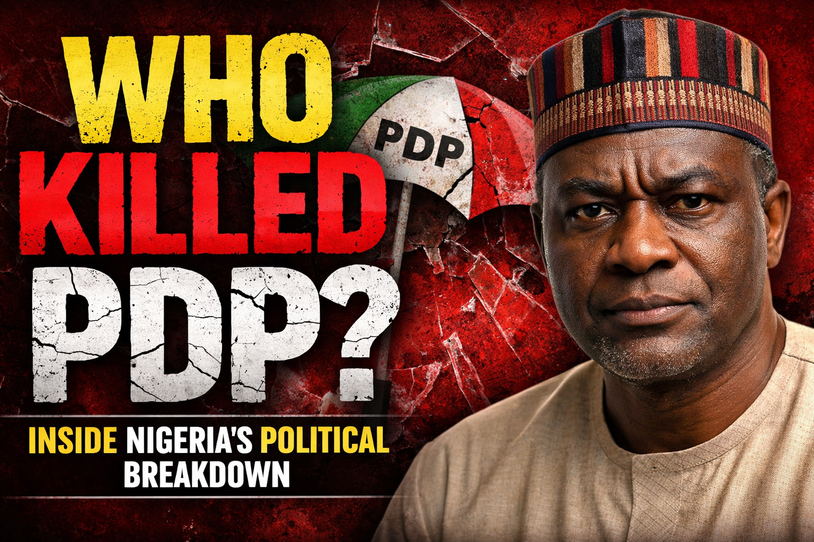
Nigeria may be witnessing the quiet collapse of one of the most consequential political parties in its democratic history.
In this edition of The Other Side, Rimamnde Shawulu Kwewum examines the steady unraveling of the People’s Democratic Party (PDP) — a party once central to Nigeria’s return to civilian rule, now weakened by defections, internal fractures, and unresolved power struggles.
Formed as a broad coalition to end military dominance and stabilise the post-authoritarian state, the PDP was never built around a shared ideology. Its strength lay in compromise, elite consensus, and the urgency of a historic mission. For years, that arrangement held. But the very compromises that enabled stability also planted the seeds of decline.
This analysis traces the PDP’s journey from dominance to dysfunction: recurring internal crises, contested leadership transitions, disputes over zoning and succession, and a pattern of elite opportunism that hollowed out party cohesion. Each electoral cycle deepened mistrust. Each unresolved conflict weakened institutional discipline.
With sitting governors defecting, rival factions locked in court battles, and no unified national strategy ahead of the 2027 elections, the PDP’s capacity to function as a credible opposition is now in serious doubt. What emerges is not merely a party in trouble, but the collapse of a political arrangement designed for a specific historical moment.
The episode also raises broader democratic questions. Effective opposition is essential for accountability, balance, and governance. If Nigeria loses a viable opposition without a coherent alternative emerging, the implications will extend far beyond partisan politics.
Is the PDP truly at the end of its life — or merely at the end of a chapter? And if it is fading, what will rise to fill the vacuum it leaves behind?
This conversation is essential for anyone seeking to understand Nigeria’s evolving political order as the country moves toward another critical election cycle