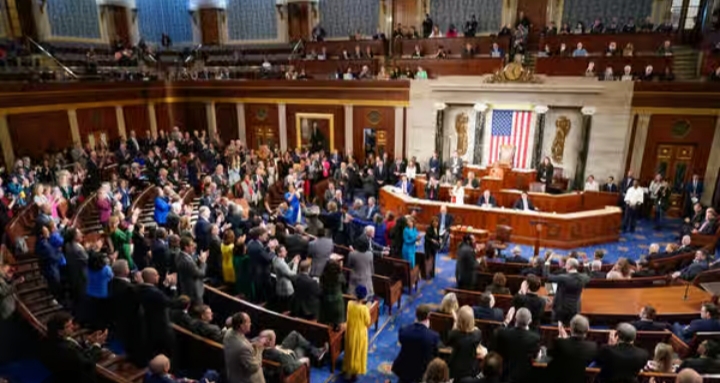
United States lawmakers have the Nigerian government for failing to take decisive steps to halt what they describe as “widespread and systematic attacks on Christian communities across the country.”
The lawmakers expressed the concern at a high level roundtable held on Tuesday on Capitol Hill, where an array of senior legislators, foreign policy specialists, and religious freedom advocates reviewed the rising tide of violence that continues to unsettle Africa’s most populous nation.
The session, which was convened under the auspices of key committees in the House of Representatives, brought together influential figures whose portfolios shape Washington’s global security posture and diplomatic priorities.
Those present included Mario Díaz Balart, vice chair of the House Appropriations Committee, and chair of the subcommittee that oversees national security interests and United States State Department funding.
He was joined by Robert Aderholt, chair of the subcommittee responsible for labour, health, human services, education, and related agencies.
Riley Moore, vice chair of the appropriations subcommittee on the legislative branch and a prominent advocate for religious liberty, also participated.
Other notable contributors included Brian Mast, chair of the Foreign Affairs Committee, and Chris Smith, chair of the Foreign Affairs Subcommittee on Africa.
The gathering further drew Vicky Hartzler, chair of the United States Commission on International Religious Freedom, as well as Sean Nelson of Alliance Defending Freedom International and Ebenezer Obadare, a senior fellow at the Council on Foreign Relations.
Participants at the meeting reviewed grim data and testimonies describing persistent assaults on Christian worshippers, clergy, farmers, and entire communities.
Smith, a long standing voice on global human rights issues, asserted that Christians and”moderate Muslims in Nigeria” are living under the constant shadow of deadly attacks launched by radical Islamist groups, including Boko Haram and violent armed Fulani elements.
According to him, Nigeria now stands at the epicentre of religiously motivated attacks globally.
Smith insisted that the Nigerian government has a constitutional and moral duty to protect its citizens, an obligation he said the authorities have repeatedly failed to meet.
He maintained that attackers operate with complete impunity and warned that Washington must not remain passive while victims continue to endure killings, kidnappings, and other abuses.
He expressed confidence that under President Donald Trump, the United States had remained committed to holding Abuja accountable and insisted that more decisive action is urgently required.
Smith went further to accuse the Nigerian authorities of attempting to buy time instead of embracing meaningful reforms.
He urged the international community to intensify pressure in order to prevent what he described as an unfolding human rights catastrophe.
Díaz Balart echoed these views, emphasising that the defence of religious liberty forms a central pillar of American foreign policy.
<span;>He insisted that no individual should live in fear because of personal beliefs or modes of worship.
The lawmaker announced that his committee will pursue the issue through a full year funding measure in the forthcoming budget cycle for the 2026 fiscal year, which he said would advance an American centred foreign policy agenda.
Several other speakers also called for increased oversight of Nigeria’s security strategies.
They advocated targeted diplomatic actions, greater engagement with affected communities, and stronger accountability mechanisms in order to address what they described as a complex and deepening crisis.
Nigeria’s prolonged struggle with religiously tinged violence has spanned more than two decades and continues to evolve in complexity.
The crisis initially gained momentum in the early two thousand with the rise of extremist movements in the North East, most notably Boko Haram, which launched relentless attacks on churches, schools, markets, and communities.
The insurgency fragmented into competing factions, some aligned with global jihadist groups, and expanded its activities across Borno, Yobe, Adamawa, and parts of the North Central region.
Over time, a wider constellation of armed actors emerged, including bandits, rural militias, cattle rustling groups, and criminal syndicates.
These networks operate across vast ungoverned spaces and have exploited longstanding tensions tied to land use, ethnicity, economic deprivation, and weak local governance structures.
One of the most sensitive aspects of the crisis has been the increasing frequency of assaults on predominantly Christian communities in Plateau, Benue, Sourhern part of Kaduna, Taraba, and other states. While Nigerian officials often attribute the violence to criminality and competition for resources, international human rights groups argue that many attacks bear a clear religious dimension.
The United States recently re-listed Nigeria among countries of particular concern for religious freedom violations.
Despite years of military operations, numerous security deployments, and significant budgetary allocations, many rural communities remain exposed to attacks.
The proliferation of small arms, the slow pace of prosecutions, and the absence of robust accountability systems have deepened mistrust and paved the way for recurring cycles of violence.
Analysts caution that unless Nigeria implements structural security reforms, strengthens intelligence coordination, and rebuilds public confidence in state institutions, the unrest is likely to persist.
Events amplified during Tuesday’s roundtable underscore the extent to which Nigeria’s internal security challenges have become an increasingly prominent feature of United States foreign policy conversations.
Washington is expected to maintain close scrutiny of developments in the coming months as lawmakers continue to push for greater protections for vulnerable religious communities and more decisive action from the Nigerian government.